What $29.90 Buys, and the Four Things CalmExpense Will Not Do
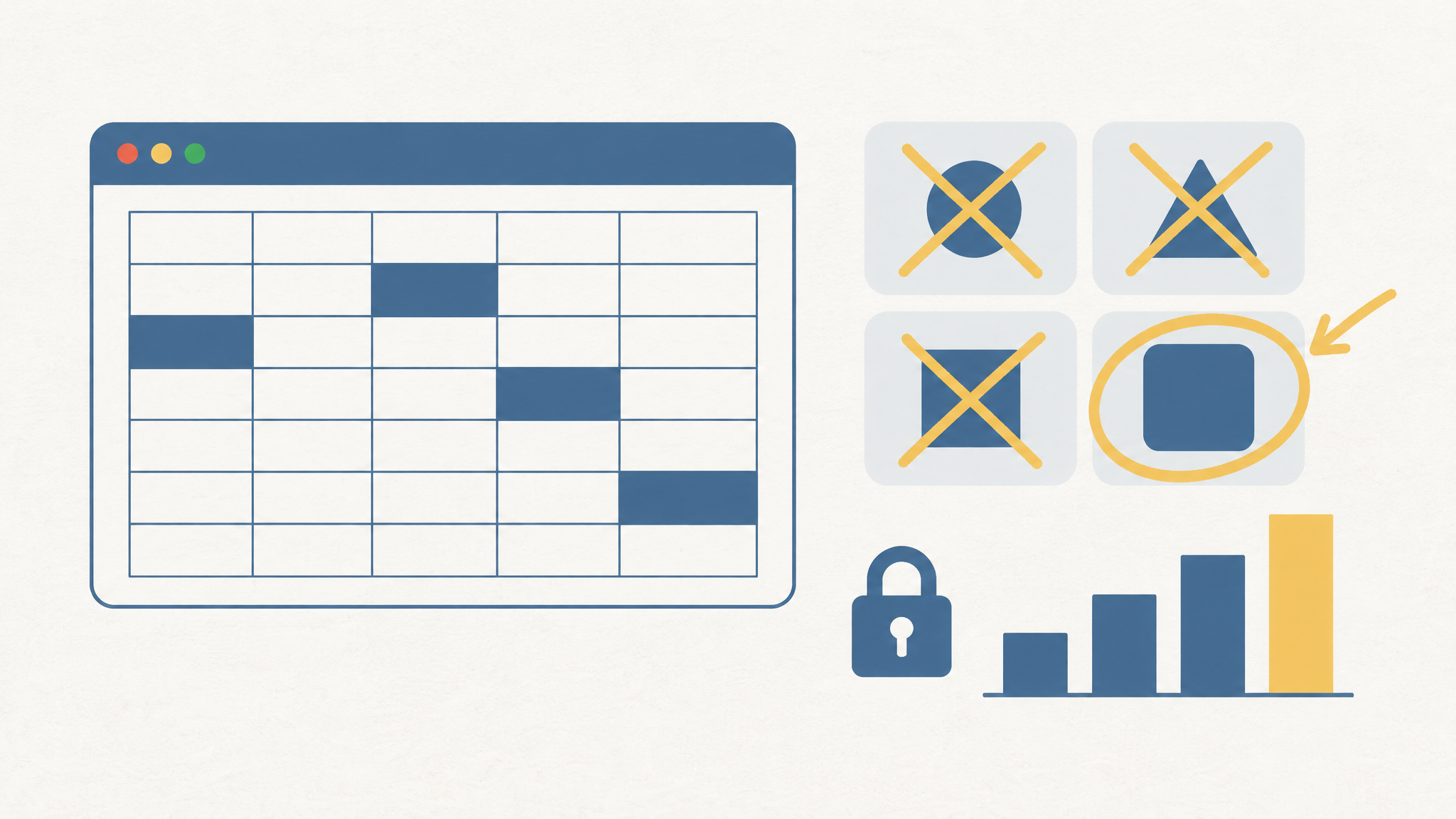
CalmExpense costs $29.90 once, after a 14-day trial that asks for no card. What that buys is a spending dashboard living inside a Google Sheet in your own Drive, built from bank CSV files you bring in yourself. What it does not buy is automatic bank sync, a mobile app, AI that reads your transactions, or a copy of your ledger on someone else's server. Each of those four refusals is deliberate, and each one rules out a particular kind of buyer.
What the one-time price covers
One payment of $29.90, discounted from $59.90, covers a working dashboard inside Google Sheets: monthly totals, category breakdowns, a savings rate, and charts drawn in a web panel instead of scattered across formula cells. The import side drops duplicate rows, rewrites merchant strings like "PAYNOW TRANSFER 8823" into something readable, and applies keyword rules so the same merchant lands in the same category every month. The realistic time cost is about 15 minutes a month, most of it spent on the monthly file from the bank. The dashboard itself is described in what the dashboard actually contains.
That is the whole product. There is no tier above it and no renewal date.
The four things it will not do
It will not connect to your bank
No Plaid, no aggregator, no stored bank token. The trade-off is real: nothing arrives on its own, so a CSV has to come from the bank each month. A bank connection is the part of a budgeting app most likely to outlive your consent, since an aggregator holds a token that keeps pulling transactions until someone revokes it. Singapore banks with two-factor prompts drop those connections often enough that the sync turns into manual work anyway.
It will not run as a mobile app
The dashboard opens in a browser, which on a phone means the Google Sheets app. There are no push notifications and no receipt photo at the till. Anyone who checks spending at the counter is looking at the wrong tool, and the browser route also means a laptop is the natural place to read the monthly numbers.
It will not use AI to read your transactions
Categorisation runs on keyword rules, not a language model. That means no chat box that answers a plain question about grocery spending, and rules that occasionally need a new merchant added. In exchange, a transaction cannot be invented or misread. Google's own API terms also bar apps from using Google user data to determine credit-worthiness or for lending, which is a useful line to know when any finance app asks for Drive access.
It will not keep a copy of your data
There is no database on the vendor side. The ledger is a Google Sheet in your Drive, which is why the privacy claim is structural instead of a promise, and it is the reasoning behind keeping financial data in your own Google Drive. The cost of that: no vendor-side backup if the file is deleted, and no dashboard when signed out of Google. Small apps also trigger Google's "unverified app" warning below 100 users, and that warning caps new users at 100 until the developer completes verification.
What the limits cost in hours
Twelve monthly files a year, at roughly 15 minutes each, is about three hours of admin annually. That is the honest price of skipping bank linking, and it is the number to weigh against a subscription fee. Anyone unwilling to do a monthly import is a poor fit, because the dashboard is only as good as the last file that went in. The work is also front-loaded: the first month takes an evening, and the eleventh takes about ten minutes.
What the alternatives charge for the same job
| Option | Cost | Bank connection | Where the ledger lives |
|---|---|---|---|
| YNAB | about S$147 a year | Yes, through an aggregator | Vendor cloud in the US |
| Monarch | $120 a year | Yes | Vendor cloud |
| Tiller | $89 a year | Yes, through Plaid | Your Google Sheet |
| Spreadsheet template | $15 to $49 once | No | Your Drive |
| CalmExpense | $29.90 once | No | Your Drive |
Automation and data ownership pull in opposite directions, and the table shows the price of each. Stretched over three years the gap widens: YNAB lands near S$441, Monarch at $360, Tiller at $267, and CalmExpense stays at $29.90 because there is no second payment. A $49 template is still $49. Tiller is the closest structural match and charges $89 every year for a sync that does not work reliably with DBS, OCBC or UOB accounts. A static template costs less than CalmExpense and leaves every category total to be maintained by hand.
Who this is wrong for
This is the wrong product for anyone who needs automatic sync, a phone app, zero maintenance, or AI chat. It is also wrong for a work Google account, since Workspace admins can block unverified apps outright. It fits readers who need the ledger in a file they control and treat the monthly import as a fair price for that. CalmExpense is built for that group, and the four refusals are why the price is paid once. If the four refusals above read as features, the pricing page has the current figure and the trial terms.
FAQ
Does it work with any bank?
Any bank that exports CSV works, which covers the major Singapore banks and most others elsewhere. Column names differ between banks, so the first file of a new type takes longer than the twelfth. What a budgeting app can see in your Google account covers the access side of that question.
Is $29.90 a subscription?
No. It is one payment, currently discounted from $59.90, with a 14-day trial that does not ask for a card.
What happens to the Sheet if the product disappears?
Nothing. The file, the formulas and the history stay in your Drive. That is the practical difference between this and a subscription that stops working when the company does.
Why does Google show a warning during signup?
Apps that request Drive access and have not completed Google's verification show an unverified app screen, and new users are capped at 100 until verification finishes. The warning reflects the developer's paperwork, not a specific risk in the Sheet.
This content provides general financial education and product-use guidance, not individualized financial, investment, tax, or legal advice. CalmExpense is not affiliated with or endorsed by DBS, OCBC, UOB, or any financial institution. DBS, OCBC and UOB are trademarks of their respective owners.
See your own spending this clearly
CalmExpense turns your bank statement into a clean dashboard inside your own Google Sheets. No bank linking, no subscription. One payment of $29.90.
Start your free trial