Five Years of a Budget App Costs $545. What You Keep Is a CSV.
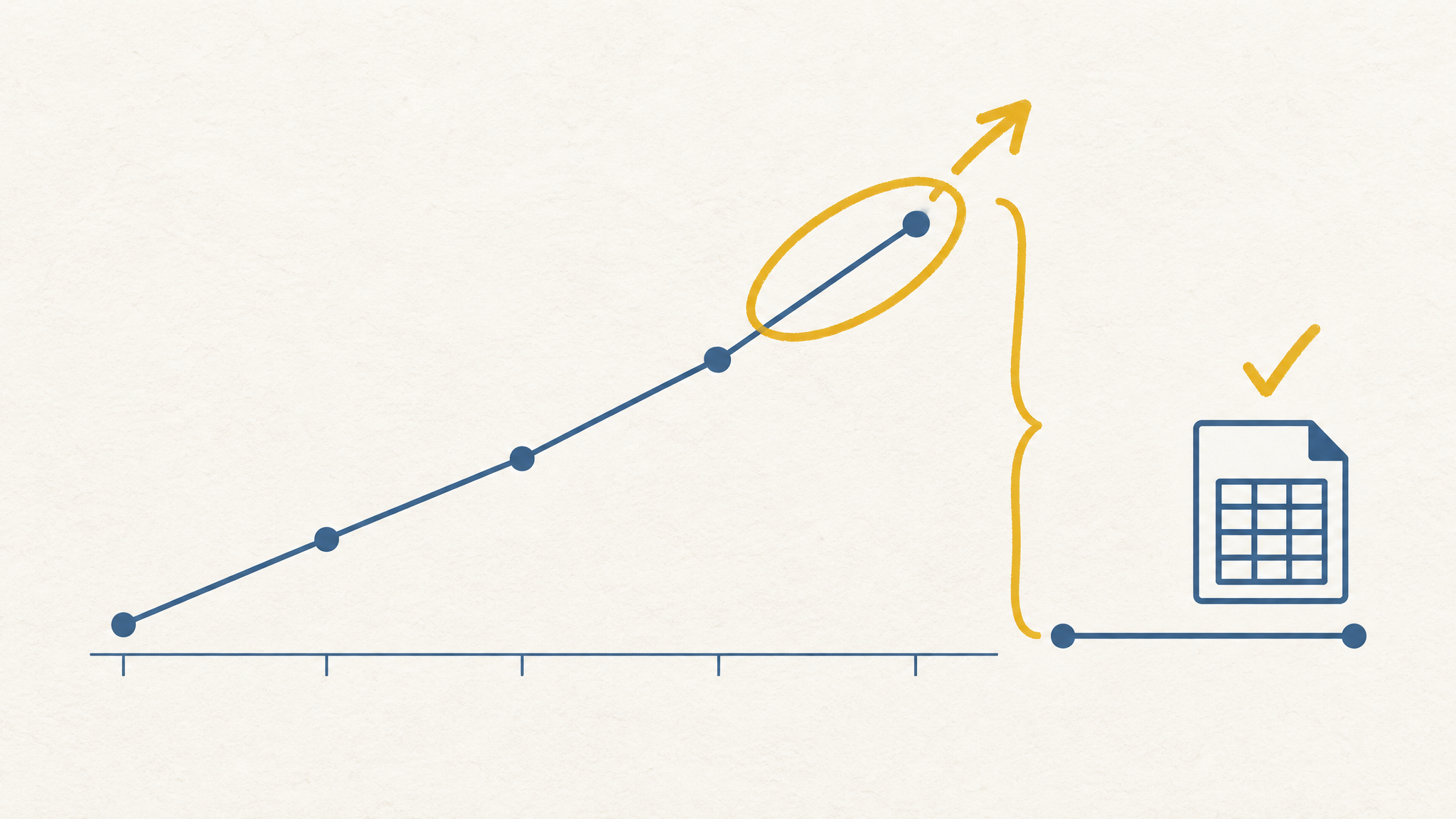
A YNAB subscription at $109 a year costs $545 over five years. When it stops, what you keep is a CSV export: one row per transaction, with dates, amounts, merchant strings and a category column. The rules that turned those rows into a budget stay behind in the app.
CalmExpense is $29.90 once, and the ledger it builds is a Google Sheet in your own Drive. Five years from now that file still opens, with the keyword rules and the merchant cleanup still attached to it.
Rental and ownership are the two pricing models in this category, and the gap between them widens with every renewal.
What five years of each option costs
The figures below are annual plans as listed on each company's site on 21 November 2026, in US dollars.
| Option | Price | Five years | What you keep if you stop paying |
|---|---|---|---|
| YNAB | $109 a year | $545 | A CSV export of transactions. The budget rules stay in the app. |
| Monarch, Core plan | $99.99 a year | $499.95 | A CSV export, with the same limit. |
| Tiller | $99 a year | $495 | The Google Sheet, because Sheets is where the data already lives. |
| Boldin, PlannerPlus | $168 a year | $840 | An export. The plan logic stays in the app. |
| CalmExpense | $29.90 once | $29.90 | The Google Sheet, the keyword rules and the dashboard. |
Tiller deserves a note, because it is the closest thing to a fair fight. Its data sits in a Google Sheet, so stopping the subscription leaves the rows behind. What stops is the feed that fills them, and the bill is still annual. The same split shows up in free templates that charge for the automation: the file costs nothing and the part that fills it does not.
The price is the one number you do not control
Boldin told its users that PlannerPlus would move from $144 to $168 a year for new subscribers from 15 October 2026, which is $24 more for the same software (boldin.com). One increase of that size is easy to absorb. The pattern is the expensive part. A single $24 rise repeated each year adds $120 to a five-year bill, and nothing in the subscription stops the next one.
A one-time price takes that decision off the table. $29.90 is the whole number, and there is no renewal to renegotiate.
What an export carries, and what it does not
A CSV file holds columns. A budget holds logic: which merchant string becomes which category, which charge repeats every month, which goal is funded by which transfer. The export keeps the first and drops the second, which is why switching tools usually means rebuilding the categories by hand from a list of rows.
The categories arrive as text rather than as rules. Nothing in the file records that a merchant string beginning with GRAB becomes Transport, or that a charge on the 3rd of every month is the gym membership at $89.00. Those two facts are the difference between a ledger and a pile of rows, and they are the first thing an export loses.
That is the part of the five-year total that never appears on a pricing page. The subscription buys a working system for as long as you pay, and the exit costs the categorising work a second time.
CalmExpense keeps the logic inside the file. The keyword rules are rows in the sheet, the categories are cells in Google Sheets, and the dashboard reads them. If the product disappeared tomorrow, the sheet would still open and still total. The dashboard would be gone, and the numbers would not.
Where a one-time price changes the incentives
A subscription business is paid to keep you renewing, so its roadmap answers to the renewal. A one-time price is paid before the work, which carries its own risk: no recurring revenue to fund support, and no contractual obligation to keep shipping. CalmExpense is one person's work, updates are best effort, and there is no support plan to buy. The trial runs 14 days and asks for no card, so the judgement can be made on the file rather than on a sales page.
What that buys you is a different failure mode. If the developer stops, you keep a working sheet. If a subscription vendor stops, you keep an export.
Who this comparison does not help
If automatic bank sync is the feature you actually want, a subscription is the honest answer, and CalmExpense will disappoint you. There is no bank connection, no Plaid, and no AI reading your transactions. Importing is a manual CSV step, the product runs in a browser on top of Google Sheets with no mobile app, and Google shows an "unverified app" warning to new users while the app is under 100 users.
Those are real costs, and they are part of why the price is $29.90 once rather than $109 a year. The four things CalmExpense will not do covers the rest of the list.
The number that matters in year six
Five years of YNAB is $545 and five years of CalmExpense is $29.90, but the comparison only gets interesting at the point where one of them stops. The subscription stops working. The sheet does not.
The one-year version of this comparison, what you actually pay, own and share with YNAB, reaches the same conclusion with a shorter horizon.
Questions readers ask
Is a CSV export from a budgeting app enough to rebuild my history?
The rows survive, with dates, amounts, merchants and categories. The rules do not, so the history arrives as a list rather than a system, and the categories have to be assigned again from scratch.
Does CalmExpense keep working if the developer stops updating it?
The Google Sheet keeps working, because it is a normal sheet in your Drive. The dashboard interface would stop, and the totals, the categories and the rules would stay readable.
Why does a subscription cost more if it includes support?
Support is part of what the renewal pays for. A one-time price trades that away for a lower total and no obligation on either side, which is a fair trade only if the support is something you would use.
What happens to my categories if I stop paying for a subscription?
The export is the part that survives a lapsed subscription, and it survives as rows rather than rules. The category names travel with the transactions. The logic that assigned them does not.
This content provides general financial education and product-use guidance, not individualized financial, investment, tax, or legal advice. CalmExpense is not affiliated with or endorsed by DBS, OCBC, UOB, or any financial institution. DBS, OCBC and UOB are trademarks of their respective owners.
See your own spending this clearly
CalmExpense turns your bank statement into a clean dashboard inside your own Google Sheets. No bank linking, no subscription. One payment of $29.90.
Start your free trial