
My Emergency Fund Is 4 Months of Expenses, Not 6. Here's the Math
Everyone says you need six months of expenses in the bank. I ran the numbers on my own situation and settled on four. This post shows the exact math, what changed my mind, and why the rule of thumb hides a question only your own transaction history can answer.
Scope: I use the Singapore median of S$1,986 in monthly expenses as the running example. Swap in your own average and the steps stay the same.
Why I stopped defaulting to six months
Six months was never a number I arrived at. It was just the default I heard repeated, so I repeated it too.
Then I sat down and asked what my emergency fund is actually for. In my case: a stretch without income, plus one or two surprise bills that can't wait. A rule of thumb assumes everyone faces the same risks at the same scale. Two people can have identical incomes and need wildly different funds, because their spending, obligations, and job stability differ.
So I stopped asking "how many months is standard?" and started asking "how many months of my own baseline covers the worst case I can actually see coming?" The answer was four.
The baseline is the whole game
An emergency fund is measured in months of expenses, so the baseline decides everything. Not your income. Not what your friend keeps. What you actually spend in an average month.
If your spending looks like this, your baseline is around S$1,900:
| Category | Average per month |
|---|---|
| Food/Dining | S$720 |
| Groceries | S$560 |
| Transport | S$180 |
| Gym Membership | S$89.00 |
| YouTube Premium | S$22.98 |
| Shopping | S$330 |
| Total | S$1,902 |
That's a small step under the Singapore median of S$1,986 a month. If you have never added your own categories up, any number you pick for this table is a guess, and an emergency fund built on a guess is just a wish.
To get the baseline from a sheet that already has a month-total column, these three formulas are the whole job:
=AVERAGE(B2:B13)          average of your last 12 month totals
=ROUND(AVERAGE(B2:B13),0) same, rounded to whole dollars
=C2*4                     your target for 4 months (change 4 to 3, 6, or 12)
If you are also trying to raise your savings rate at the same time, the exact math in my savings rate post shows how to measure progress month to month instead of guessing.
What the multiples actually cost
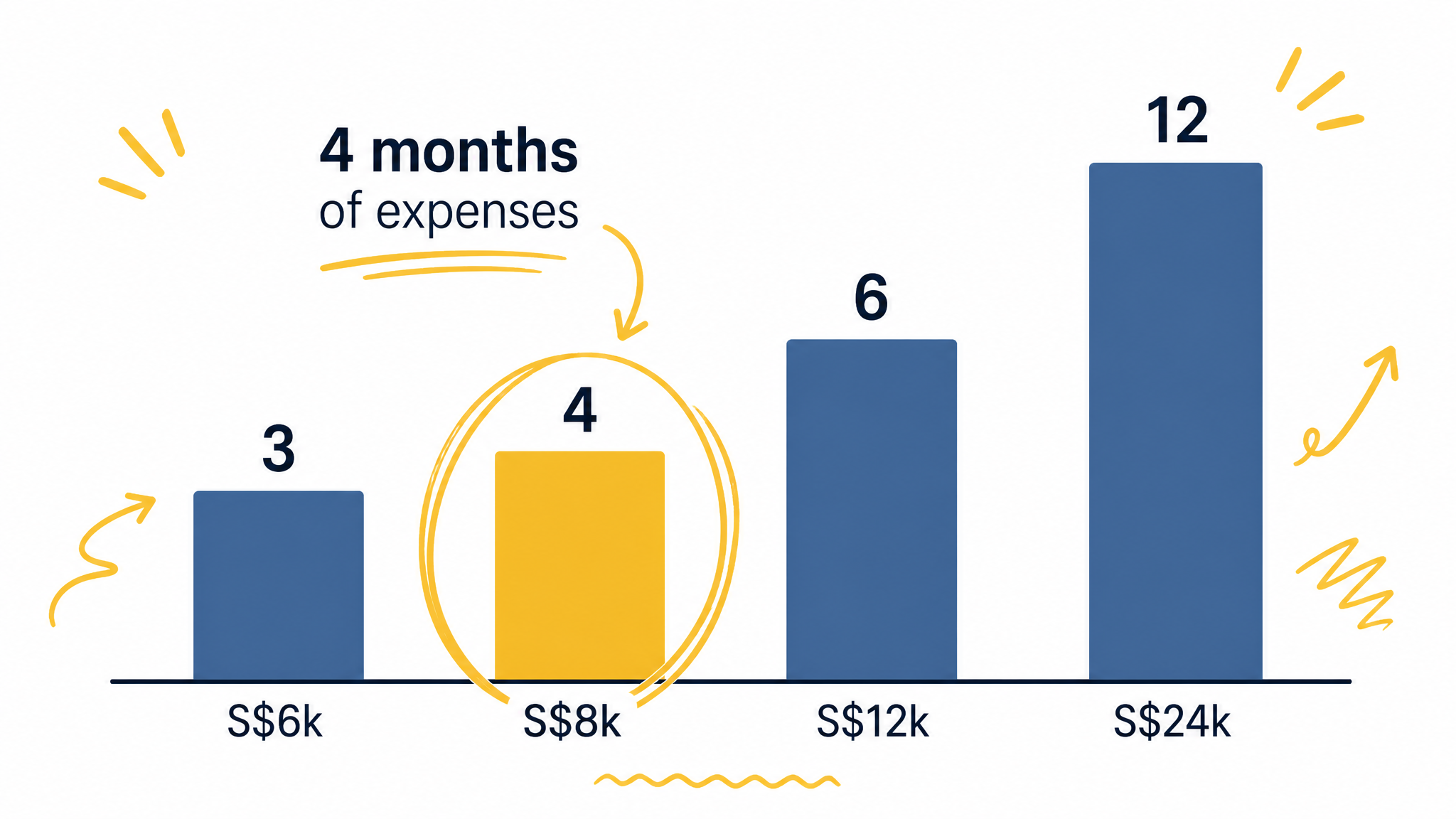
Here is the table I wish someone had shown me earlier. At the median baseline of S$1,986:
| Months of expenses | Lump sum | What that covers |
|---|---|---|
| 3 months | ~S$6,000 | Short gap, stable job, low fixed obligations |
| 4 months | ~S$8,000 | A few months between paychecks plus one surprise bill |
| 6 months | ~S$12,000 | Slow job market, single-income household, dependents |
| 12 months | ~S$24,000 | Freelance income, health uncertainty, long recovery |
Round every target up, not down. An emergency fund is not the place to round to the nearest nice number below what you need.
I keep four months because my realistic worst case is a few months between paychecks plus one large bill, and my fixed costs are modest. Six would sit idle for years earning nothing meaningful. Twelve would be money parked instead of working toward anything. Four covers the risk I can actually see, and the difference goes to goals with a date attached.
How long it takes to fill
The lump sum matters less than the monthly habit, so I looked at what I could redirect rather than what I "should" save.
| Redirected per month | Time to fill ~S$8,000 |
|---|---|
| S$219 | ~36 months |
| S$400 | ~20 months |
| S$500 | ~16 months |
The first row is not hypothetical for me. When I audited my recurring charges I found about S$219 a month in subscriptions I had forgotten about, and that money went straight into the fund before I could spend it on anything else.
The step everyone skips: knowing your real baseline
Here is the uncomfortable part. None of this math works unless the baseline is real, and the baseline is only real if your transactions are categorized and added up correctly. That means dealing with a year of bank CSVs, messy merchant names, and transfers that look like expenses but are not.
This is the step where most people give up and go back to the six-month rule of thumb. It is also where I stopped pasting raw statements into an AI chatbot and asking it to do the work, because I did not want my bank data sitting on someone else's servers.
I now keep a Google Sheets dashboard that reads downloaded CSVs from DBS, UOB, or OCBC directly, drops every transaction into a category, and totals the months for me. It lives in my own Google Drive, no bank login is shared with anyone, and it cost a one-time S$29.90 instead of a yearly subscription. If you want to see how the categorization logic works without a dashboard, I wrote up the exact categorization formulas I use, and if you prefer the no-bank-link route, this tracking setup walkthrough shows how the pieces fit together.
Once the baseline is real, the emergency fund decision takes ten minutes. Before that, every month count is a guess, and guessing is how people end up with either too little buffer or too much money sitting idle.
Frequently Asked Questions
Is six months ever the right answer? Yes, and it usually comes down to income stability and obligations. If your income is commission-based, you are the only earner, or a long illness would wipe you out, six to twelve months is defensible. The point is to pick from your situation, not from a default.
What should go into the baseline? Fixed and regular spending: food, transport, groceries, memberships, subscriptions, and the shopping you actually do. Leave out one-off blowouts. If you have annual bills like insurance, divide the yearly amount by 12 and add it, or they will ambush the months after you set the target.
Should I invest my emergency fund? No. It is insurance, not an investment. Keep it in a separate savings account where it cannot vanish with the market on the same week you lose your job.
What counts as an emergency? A job loss, a medical bill, a broken appliance you depend on, a flight for a family emergency. A sale on shoes is not an emergency, and neither is a "good deal" on anything. When in doubt, ask whether this would still be urgent in three weeks.
How do I know my real baseline if I have never tracked properly? Start with the last three months of bank statements, categorize every transaction, and average the totals. That gets you 90% of the way. The formulas above turn the sheet into a number in about ten minutes.
Last updated: 7 September 2026
See your own spending this clearly
CalmExpense turns your bank statement into a clean dashboard inside your own Google Sheets. No bank linking, no subscription. One payment of $29.90.
Start your free trial