
I Was Paying $219 a Month in Subscriptions I Forgot About. Here's How I Found Them
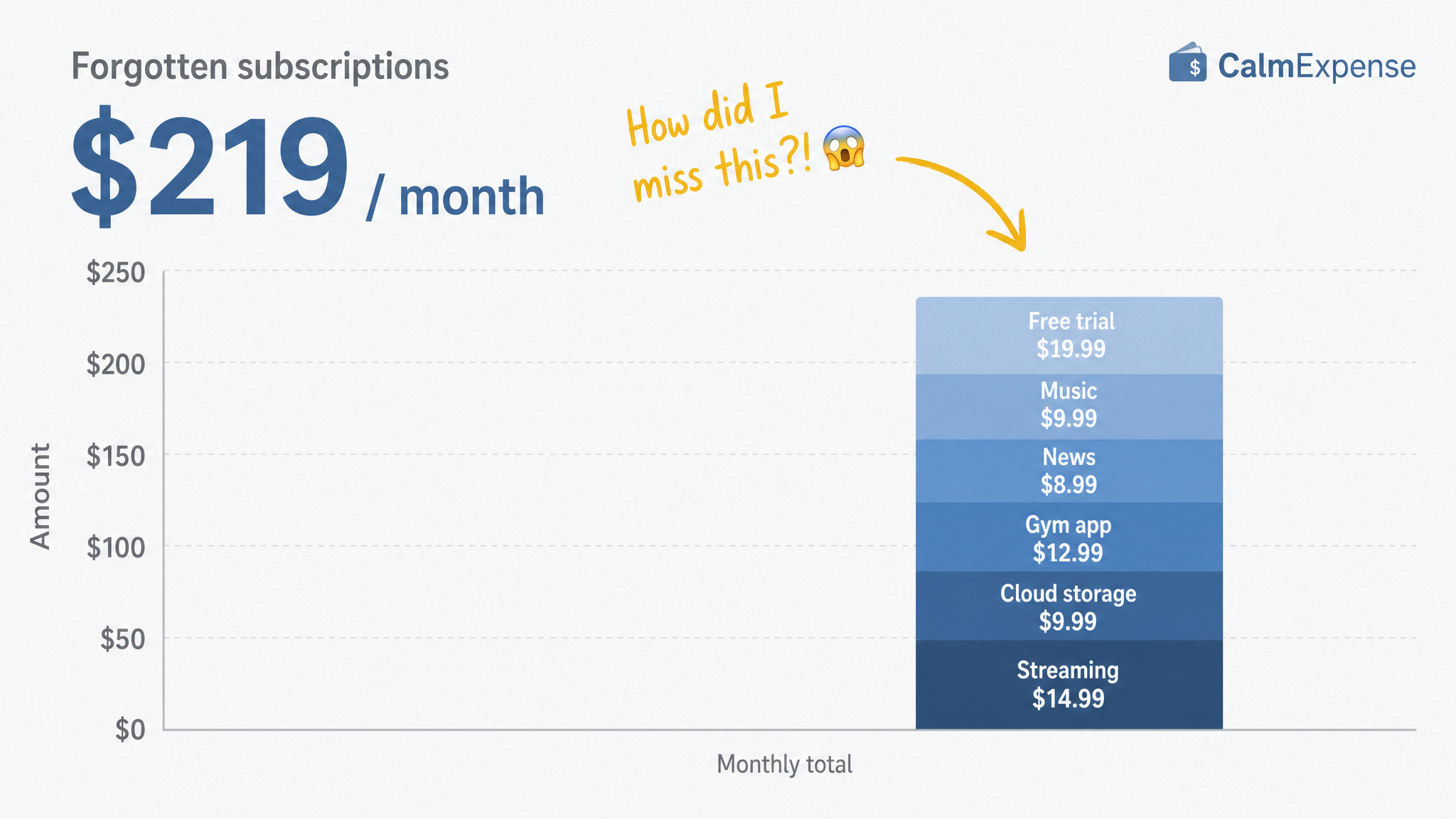
I pulled my bank and credit card statements one weekend and listed every recurring charge. I thought I was spending maybe $80 or $90 a month on subscriptions. The actual number was $219.
Not $219 across a household. $219 from my own accounts. I approved each of these charges at some point, and then forgot they existed.
This post walks through how I found them, what I did about it, and the exact steps you can copy. No bank login required, no app that watches your accounts. Just your statements and a spreadsheet.
What I actually found
I went through 60 days of statements, line by line, and wrote down every recurring charge. Here is the full list:
| Subscription | Monthly cost | Verdict |
|---|---|---|
| YouTube Premium | $22.98 | Keep |
| Gym membership | $89.00 | Cancel |
| iCloud storage | $2.99 | Downgrade to free |
| Adobe Creative Cloud | $22.99 | Cancel |
| Streaming service | $19.99 | Cancel |
| VPN | $12.99 | Cancel |
| Note-taking app | $8.99 | Cancel |
| Streaming add-on | $9.99 | Cancel |
| News subscription | $14.99 | Cancel |
| Cloud backup | $14.09 | Cancel |
Total: $219 a month. That is $2,628 a year. For things I mostly was not using.
The gym was the worst. $89 a month and I had not been since March. That is $534 for six months of not going. The VPN was from a free trial that rolled into a paid plan. The news subscription started when I wanted to read one article behind a paywall.
The scary part was not the total. It was that I had no idea. I approved each of these charges once, months or years ago, and then never looked again.
Why subscriptions are so easy to forget
Subscriptions are designed to be forgotten. One-click signups, free trials that roll into paid plans, and cancellation flows that make you click through three screens and answer a survey. The product teams know that if you have to think about it, you might cancel.
So the money just leaves. $9 here, $15 there. Small enough to never trigger a reaction, big enough to add up to real money by the end of the year.
A $9 charge feels like nothing. But $9 a month is $108 a year. Ten of those is over a thousand dollars. That is a flight, or a few months of groceries, or a meaningful chunk of savings.
The 60-day audit, step by step
You don't need a fancy tool for this. You need your statements and about 30 minutes.
Step 1: Pull 60 days of statements. Log into your bank and credit card portals and download the last two months. If you use a few cards, get them all.
Step 2: List every recurring charge. Go line by line and write down anything that repeats. Include annual charges too, like a $99 renewal that only shows up once a year. Those are the sneakiest.
Step 3: Ask three questions about each one.
- Did I use this in the last 30 days?
- Would I pay full price for it today?
- Is there a free or cheaper alternative?
Step 4: Cancel the no's. For anything you didn't use and wouldn't repurchase, cancel it. For the ones you use occasionally, look for a pause option or a cheaper tier.
Step 5: Set a review date. Put a reminder in your calendar for 90 days out. Subscriptions creep back. A regular review keeps them honest.
What I actually did with mine
I cancelled the gym, Adobe, the VPN, the streaming service, the note-taking app, the streaming add-on, the news subscription, and the cloud backup. That is $193 a month gone, or $2,316 a year.
I kept YouTube Premium, because I use it daily and it is worth it to me. I downgraded iCloud to the free tier.
The whole thing took me about 40 minutes. And it is not a one-time win. I now do a 90-day sweep, and every sweep finds at least one thing I had forgotten.
One trick that works for entertainment: rotate instead of stack. Instead of paying for two or three streaming services at once, keep one active, finish what you want, then switch. You get the same shows and pay a fraction of the price. I do this now and it saves me about $20 a month on top of the cancellations.
The connection to tracking
The reason I missed those charges is that I was not looking at my actual spending. I was relying on memory, and memory is terrible at recurring charges.
That is why I started tracking every transaction in a spreadsheet instead of trusting myself to remember. When the data is in front of you, categorized and totaled, the leaks become obvious. You stop asking "where did my money go" and start seeing exactly where it went.
If you're doing this manually in Google Sheets, you already have the right idea. The friction is the data entry. That is the part I wanted to remove, which is why I built CalmExpense. It's a one-time $29.90 purchase that puts your data in your own Google Drive, no bank login and no subscription. You upload your bank CSV, it categorizes the transactions, and you get the same clear picture without the monthly fee. If you want the manual approach, you can read about how to import your bank statements, or see how I automate the categorization in Google Sheets.
A quick FAQ
How many subscriptions does the average person have? Around 12, according to recent data, and most people underestimate the total by more than half.
Should I cancel everything? No. Keep the ones you actually use. The goal is to stop paying for things you forgot, not to live without things you enjoy.
How often should I check? Every 90 days is a good rhythm. Set a reminder so it actually happens.
Do I need an app to track subscriptions? No. A spreadsheet and your statements work fine. The app is a convenience, not a requirement.
The bottom line
I found $2,316 a year in subscriptions I had forgotten about, and I am someone who tracks his spending. If it happened to me, it is probably happening to you.
The fix is not complicated. Pull your statements, list the recurring charges, and cancel what you don't use. Then set a reminder to do it again in 90 days.
Updated: September 2026
See your own spending this clearly
CalmExpense turns your bank statement into a clean dashboard inside your own Google Sheets. No bank linking, no subscription. One payment of $29.90.
Start your free trial